
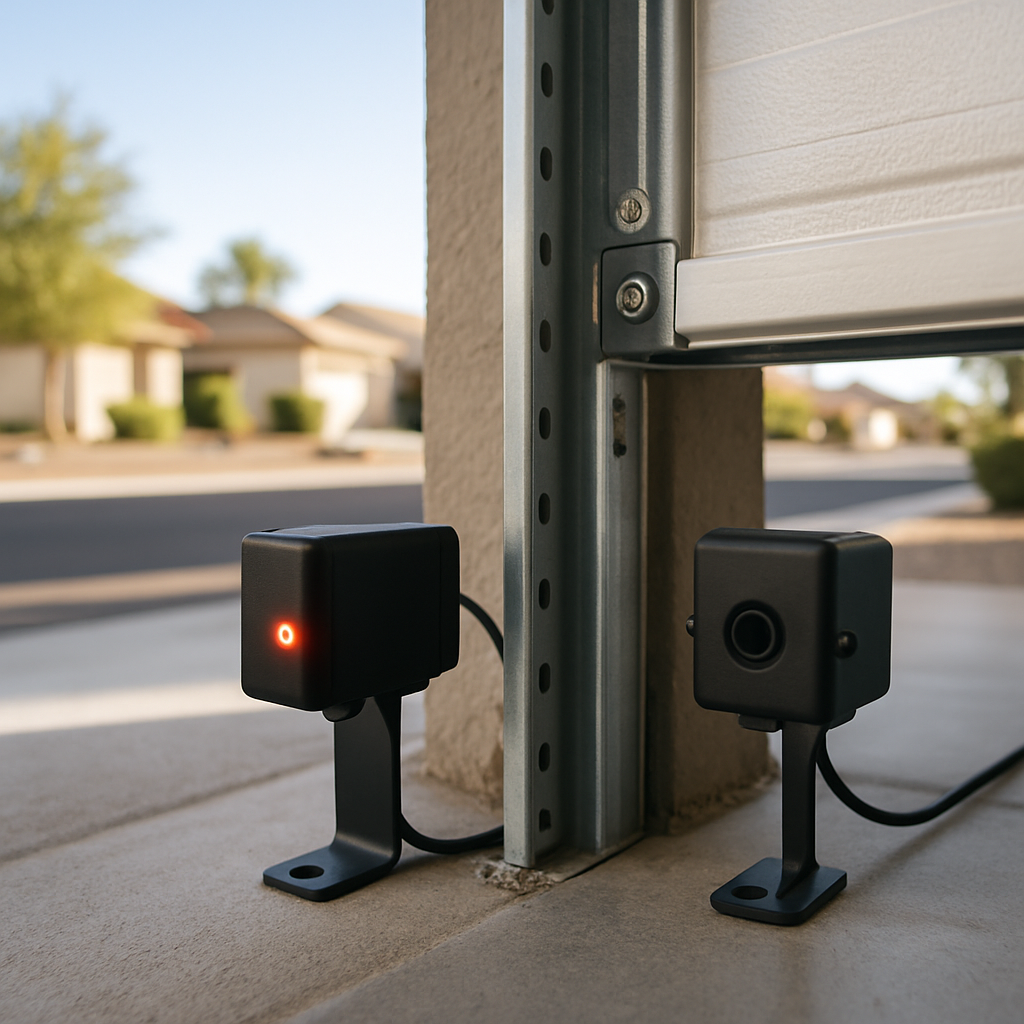
Garage door safety sensors are one of the most important protective features built into your automatic garage door system. These small devices sit near the base of your door tracks on both sides, creating an invisible beam that detects obstructions in the door’s path. When that beam is broken, the door is designed to stop or reverse immediately, protecting children, pets, and property from serious injury or damage. Understanding how garage door safety sensors function can help you recognize problems before they become dangerous.
For Phoenix, Arizona homeowners, a malfunctioning garage door can be more than an inconvenience. It can be a genuine safety risk for your family. When sensors fail, a door may refuse to close entirely, reverse unexpectedly, or worse, close when it should stop. These are not problems you want to ignore, especially in a busy household where kids and pets move in and out of the garage throughout the day. Knowing the signs of sensor trouble puts you in a better position to act quickly and protect what matters most.
If you are already experiencing issues with your garage door system, the team at Loves Garage Doors is ready to help. You can learn more about what we do by visiting our Services page, where we outline everything from sensor alignment and repair to full system installations across the Phoenix area.
Whether your door is acting up for the first time or you have been dealing with an ongoing issue, understanding the root cause is the first step toward a lasting fix. Loves Garage Doors serves homeowners throughout the greater Phoenix area and is licensed, bonded, and insured so you can feel confident about who is working on your home. We stand behind our work with a satisfaction guarantee and always provide free estimates before any job begins.
How Garage Door Safety Sensors Actually Work
Garage door safety sensors operate using a photoelectric beam system. One sensor, called the sending unit, emits a continuous infrared beam of light. The other sensor, called the receiving unit, sits directly across from it on the opposite side of the door opening. As long as that beam travels uninterrupted from one sensor to the other, your garage door opener knows it is safe to close. The moment something breaks that beam, the opener receives a signal to stop or reverse the door’s movement.
Most sensors are mounted approximately four to six inches off the ground, which is low enough to detect a small child, a pet, or a box left in the doorway. Each sensor typically has a small LED indicator light that tells you whether it is functioning correctly. A solid green or yellow light usually means the sensor is aligned and receiving the beam properly. A blinking or red light typically signals that the beam is misaligned or something is interfering with it. Learning to read these indicators is one of the fastest ways to diagnose a problem without any special tools.
The technology behind garage door safety sensors is straightforward, but that simplicity does not make them immune to failure. Over time, dirt accumulation, physical bumps from vehicles or lawn equipment, wiring degradation, or sun exposure can all degrade sensor performance. In Phoenix specifically, intense heat and UV exposure can accelerate wear on the sensor lenses and housing, making regular inspection particularly important for local homeowners.
- Keep sensor lenses clean by wiping them gently with a dry cloth every few months to remove dust and debris buildup.
- Check for direct sunlight hitting the receiving sensor, as intense sun can overwhelm the infrared signal and mimic an obstruction.
- Inspect the sensor mounting brackets after any accidental bumps from a car, bicycle, or lawn equipment that passes through the garage.
- Look at the LED indicator lights on both sensors regularly to catch alignment issues before they become a recurring problem.
- Examine sensor wiring for any visible fraying, kinks, or areas where the wire has been pinched or damaged along the door track.
- Avoid hanging items like garden hoses or extension cords near the sensor area where they could swing into the beam path.
- Test the sensors monthly by placing a cardboard box in the door’s path and confirming the door reverses upon contact.
Common Reasons Garage Door Safety Sensors Stop Working
There are several reasons why garage door safety sensors fail, and most of them can be traced back to one of three categories: physical misalignment, environmental interference, or electrical issues. Misalignment is the most common culprit. If one sensor gets bumped out of position even slightly, the beam can no longer reach the receiving unit cleanly. This is often what causes a door to go down a few inches and then reverse back up without any visible obstruction in the way.
Environmental interference is a frequent problem for Phoenix homeowners in particular. The desert sun is powerful, and when it shines directly at the receiving sensor during certain times of day, the sensor can become temporarily blinded by the ambient light. Spiderwebs, fine dust, and wind-blown debris can also coat the sensor lenses and scatter the infrared beam. These issues are often seasonal and can be resolved with cleaning and strategic shade, but they can also mask a deeper hardware problem that requires professional attention.
Electrical failures, while less common, are the most serious cause of sensor malfunction. Wiring that has been chewed by pests, corroded by moisture, or damaged by heat can cut off the signal between the sensors and the garage door opener’s control board. In some cases, the sensors themselves burn out and need to be replaced entirely. When you visit the Home page of our website, you can get a full picture of the professional repair services Loves Garage Doors provides for homeowners throughout Phoenix and the surrounding communities.
- Start by visually inspecting both sensors to confirm they are mounted securely and pointing directly at each other without any visible tilt or rotation.
- Check the LED lights on each sensor unit and note whether they are solid or blinking, as this tells you immediately whether the beam connection is stable.
- Clear any debris, spiderwebs, or dust from the sensor lenses using a soft, dry cloth, being careful not to scratch the surface.
- Look for direct sunlight exposure on the receiving sensor and consider whether a temporary shade or repositioning of the unit might resolve intermittent issues.
- Trace the sensor wiring from each unit up to the garage door opener motor, checking for visible damage, fraying, or disconnected wire terminals.
- Reconnect or tighten any loose wire connections at the sensor terminals and at the back of the opener unit itself.
- If the sensors still fail to operate correctly after these steps, contact a licensed garage door professional to test the sensors with diagnostic equipment and recommend replacement if needed.
FAQ: Garage Door Safety Sensors
Why do my garage door safety sensors keep blinking?
Blinking sensor lights almost always mean that the infrared beam between the two sensors is not connecting properly. This is typically caused by misalignment, where one or both sensors have shifted out of position. It can also be caused by dirt or debris on the lens, an obstruction in the beam’s path, or a wiring issue preventing proper communication. Adjusting the sensor brackets so both units point directly at each other, then cleaning the lenses, resolves the problem in most cases. If the blinking continues, it is time to call a professional because the issue may be electrical.
Can I bypass my garage door safety sensors?
Technically, some older openers allow manual operation if sensors are disconnected, but bypassing garage door safety sensors is strongly discouraged and potentially dangerous. These sensors exist specifically to prevent the door from closing on a person, pet, or object. Disabling them removes a critical layer of protection from your home. If your sensors are causing problems that prevent normal operation, the correct solution is to repair or replace them, not to work around them. A licensed technician can diagnose the specific failure and restore safe operation quickly.
How much does it cost to fix or replace garage door safety sensors?
The cost of repairing or replacing garage door safety sensors varies depending on whether the issue is a simple alignment fix, a wiring repair, or a full sensor replacement. In many cases, a professional service call that includes realignment and cleaning is very affordable. Full sensor replacement parts are generally inexpensive, and the labor involved is minimal for an experienced technician. Loves Garage Doors offers free estimates to Phoenix area homeowners so you always know exactly what you are looking at before any work begins. You can also reach out through our Contact page to schedule a visit at your convenience.
Conclusion: Trust a Local Phoenix Expert With Your Sensor Repairs
Garage door safety sensors are a small component with a big responsibility. When they work properly, they operate invisibly in the background, keeping your family and property safe every time the door closes. When they fail, the consequences can range from a frustrating daily inconvenience to a genuine safety hazard that puts people at risk. Phoenix homeowners deserve a fast, reliable solution from a team that understands the local environment, the intense sun exposure, and the wear patterns that come with desert living.
Loves Garage Doors is a licensed, bonded, and insured garage door company proudly serving Phoenix, Arizona and the surrounding communities. Our technicians are experienced with all major garage door opener brands and sensor systems. We stand behind every repair with a satisfaction guarantee and always provide free estimates so there are no surprises. Whether you need a quick sensor realignment or a full system diagnostic, we are ready to help you get your garage door operating safely and reliably again.
Call Loves Garage Doors — sensor issues are a safety hazard. Call: (602) 574-8588